


$378K in Collective “Negative Returns”: An AI Quant Trading Competition Just Turned Losses Into a Research Report

When a Quant Competition Loses Money, What the Market Reveals.
──────── Crypto Trading Industry Report 2026 · Executive Preview
A quantitative trading competition. Over 30 teams. 8 million USDT in real capital. 207 million in trading volume. A capital turnover rate of 13.88x. You might expect a triumphant story of outsized profits. Instead, the aggregate P&L came in at negative 378,000 USDT.
It was not one team that underperformed. It was most teams. These are the unvarnished results of Digital Quant 2026.
Yet this outcome is not a failure. It is the most honest reading of how markets actually work. If every team had generated effortless profits, the competition environment would have been too sanitized, the risk exposure too muted. Live markets are not markets where everyone wins. They are markets of extreme polarization, where the majority of strategies are ground down by friction, volatility, and competition, and only a small minority of genuinely effective strategies survive.
Aggregate losses prove market authenticity; top performers prove the efficacy of selection.
This statement is not merely an assessment of a competition. It is the central thesis of the AI-quantitative era.
I. Alpha Is in Decline
If the defining opportunity of the past decade in crypto was the expansion of asset beta, then beyond 2026, the defining opportunity in AI-quantitative markets will be the curation of strategy alpha.
The emergence of AI Agents is rapidly lowering the barrier to strategy production. Previously, a quantitative team required years of accumulated engineering capability, data infrastructure, trading experience, and risk control frameworks. Today, AI can assist with data acquisition, factor generation, strategy backtesting, trade execution, and even direct invocation of trading interfaces and on-chain protocols via protocols such as MCP. The supply of strategies is expanding. Trading bots are multiplying. The "AI-quant narrative" is becoming increasingly crowded.
But more strategies does not mean more alpha. On the contrary, as an increasing number of models converge on the same classes of spreads, trends, and event signals, the excess returns of ordinary strategies are rapidly compressed. Traditional opportunities in high-frequency arbitrage, trend following, cross-exchange arbitrage, and market-making spreads become thinner, shorter-lived, and harder to replicate. AI does not make markets easier. It makes them more efficient, and more brutal.
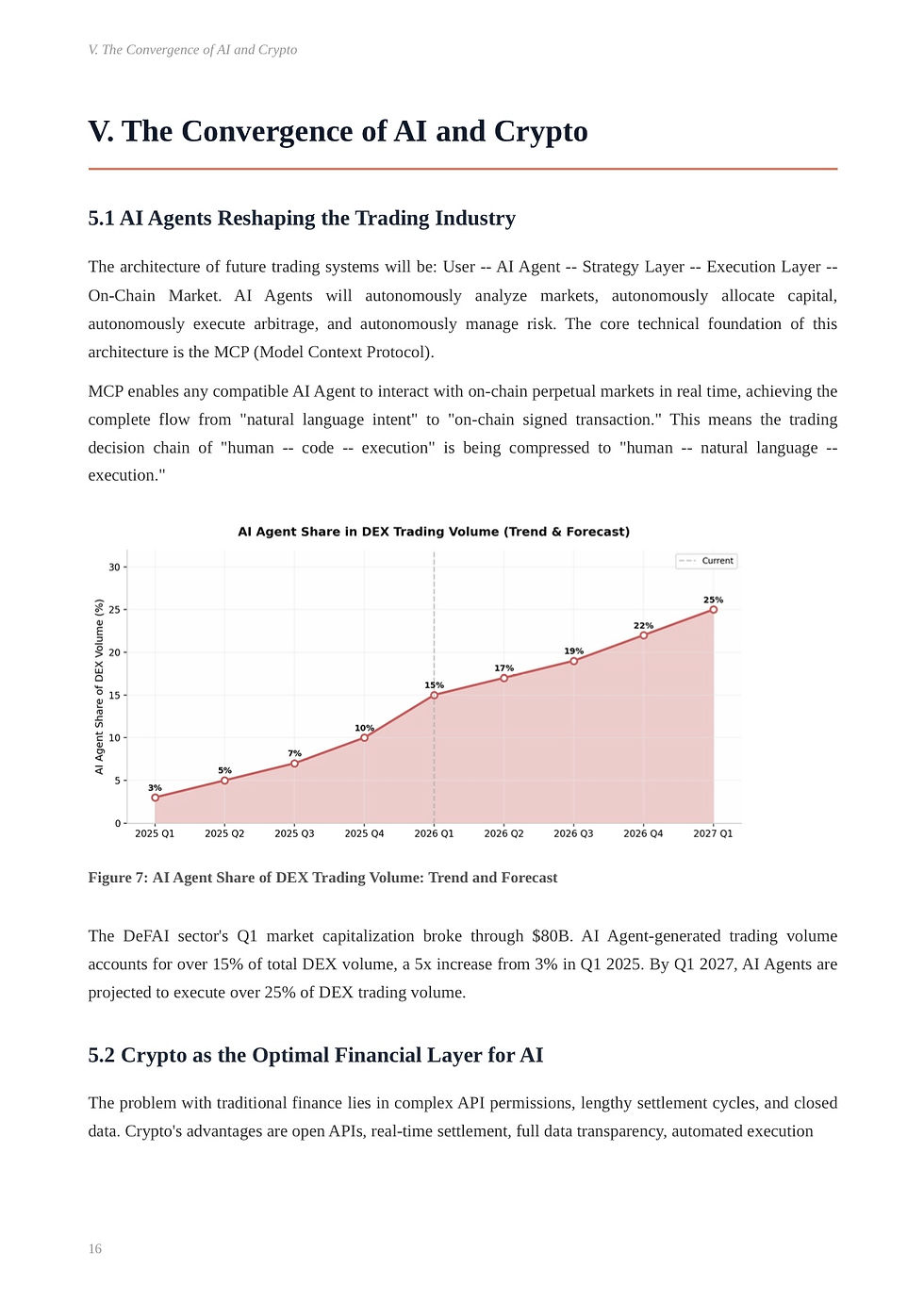
According to CoinGecko data, total global crypto trading volume reached $20.57 trillion in Q1 2026, with Perp DEX commanding 52% market share as the core liquidity venue. AI Agent-generated trading volume accounts for over 15% of total DEX volume, a 5x increase from 3% in Q1 2025. More capital is now chasing scarcer alpha.
II. Strategy Credibility Is Appreciating
Against this backdrop, a critical insight emerges: what will be truly scarce in the future is not "strategies," but "strategy credibility."
Strategy credibility is not a team claiming they use AI, nor a beautiful backtest curve. It is a strategy's demonstrated ability to prove its return generation capacity, drawdown control, capital capacity, and reproducibility under real capital, real accounts, real market frictions, long-cycle volatility, and strict risk control metrics.
In other words, when anyone can generate a strategy, value shifts from "having a strategy" to "having a credible strategy." In an era of information overflow and strategy saturation, the platform capable of efficiently and standardizingly evaluating strategies will be more valuable than the strategies themselves.
III. From Competition to Infrastructure
The significance of Digital Quant 2026 lies not in crowning a champion, but in establishing a market mechanism that enables alpha to be discovered, verified, priced, and allocated.
It can evolve along five progressive stages: Stage I is the quantitative competition itself, discovering exceptional teams and strategies through real capital live trading. Stage II is the strategy database, continuously accumulating core metrics including historical return curves, maximum drawdown, win rates, and Profit Factor. Stage III is the strategy rating system, comprehensively assessing return quality, risk control, capital capacity, and strategy stability. Stage IV is the capital matching platform, enabling capital allocation based on real data rather than brand and narrative. Stage V is strategy productization, packaging exceptional strategies as FoF vehicles, strategy indices, and copy-trading products.
This means Digital Quant's long-term objective is not merely running a competition, but establishing a sustainable AI-quantitative strategy marketplace. In this marketplace, alpha can be discovered, strategies can be compared, risk can be priced, and capital can be efficiently matched.
IV. The Endgame: A Five-Layer Architecture
Looking ahead, the market structure will form a five-layer architecture: AI Agent at the apex as the discoverer of strategies, allocator of capital, and controller of risk. The on-chain trading layer provides frictionless 7x24 execution. Perp DEX and Prediction Market provide venues for leverage and information pricing. Stablecoin Settlement provides real-time clearing. The RWA Financial Layer connects traditional assets to the on-chain world.
Within this operating system, core competition is no longer about token issuance capability or narrative crafting, but about order flow, AI, low latency, risk control systems, and cross-market liquidity. Crypto is no longer merely a "token issuance market" but the next-generation global financial operating system.
V. The Full Report
The analysis above represents only a condensed overview of the core findings from Digital Quant 2026. The complete report, CRYPTO TRADING INDUSTRY REPORT 2026, delivers in-depth analysis across the following ten dimensions:
Report Contents
I. Industry Overview: Crypto Enters the Institutional Deep End
II. Competitive Landscape Analysis
III. Trading Volume Analysis
IV. Trading Strategy Analysis (Market Making / Funding Arbitrage / Cross-Exchange / AI Signal Trading / Alpha Erosion and Strategy Credibility)
V. The Convergence of AI and Crypto
VI. Perp DEX Outlook
VII. Prediction Market Outlook
VIII. TradFi and Crypto Convergence
IX. Core Outlook for the Next Three Years
X. Conclusion
📖 Key highlights only. The full report is attached at the end of this article.

Data sources span CoinGecko, CoinGlass, DefiLlama, Datawallet, digitalquant.fund, CFTC, and BCG, covering $20.57T in global trading volume structure, $207M in micro-level empirical validation from Digital Quant 2026, and the four frontier sectors of AI Agent, Perp DEX, prediction markets, and RWA.
Because the real battlefield of AI-quantitative trading has only just opened.
📅 Official Website: Digitalquant.fund
🤝 Partnerships & Cooperation: cooperation@digitalquant.fund
About Digital Quant 2026
Digital Quant 2026 is the flagship annual event series under DeAI Expo, focused on digital asset management and AI-powered quantitative investment. It consists of two core pillars: a digital asset management forum and a digital asset quantitative trading competition.
As the world's first AI-driven, long-duration, live trading, multi-asset quantitative competition, the Digital Quant 2026 trading tournament establishes a new framework by connecting on-chain ecosystems with global financial markets. It enables trading across equities, precious metals, commodities, and crypto-native assets on major platforms including Binance, OKX, Coinbase, and Deribit. Built on an AI agent trading system powered by OpenClaw, the competition continuously evolves trading strategies through machine intelligence. Over a 60+ day live trading cycle, performance is evaluated strictly based on real data and outcomes. The initiative connects strategies, capital, and markets, aiming to build a next-generation global quantitative trading infrastructure designed for the AI era.






Disclaimer: The content herein is provided for informational purposes only and does not constitute investment advice. Markets involve risk, and investments should be made with caution. Readers are advised to make independent judgments based on their own circumstances before making any investment decisions.
About Cryptogram Venture (CGV):
CGV (Cryptogram Venture) is a crypto investment institution headquartered in Tokyo, Japan. Since 2017, its fund and predecessor funds have participated in investments in over 200 projects. Since 2022, CGV has invested in and incubated the licensed Japanese yen stablecoin JPYW, making an early move in the crypto stablecoin sector. Starting in 2024, CGV has expanded into the tokenized equity and RWA markets, participating in private placements of projects such as Nabate (NA) and Victory Securities (8540.HK). Currently, CGV also has branches in locations such as Hong Kong and Silicon Valley.


Comments